Why AI search optimization is important
in 2026 for your business
in 2026 for your business
Why AI optimization is important in 2026 for your business
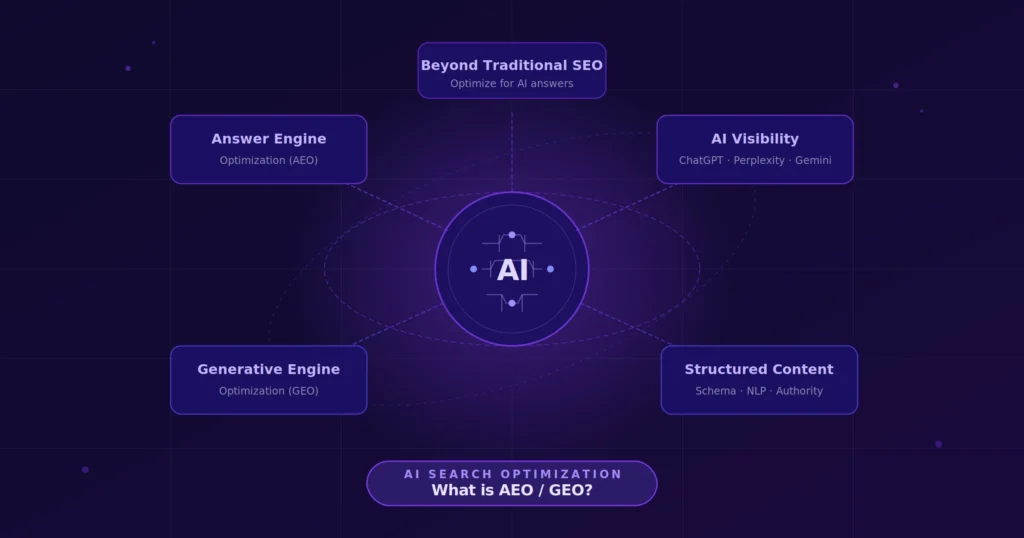
AI search optimization is the practice of optimizing your presence and content to appear in AI-powered search systems such as ChatGPT, Google, Perplexity, Claude, and others.
AI search optimization also called Answer Engine Optimization (AEO) or Generative Engine Optimization (GEO).
AI-powered platforms like ChatGPT, Google AI Overviews, Perplexity, and Claude are now part of how people discover products, compare services, and make purchasing decisions. The businesses that appear inside those AI-generated answers are the ones getting seen, trusted, and chosen.
This is where Generative Engine Optimization (GEO) comes in and why every marketer and business owner needs to understand it in 2026.
What Is Generative Engine Optimization?
Generative Engine Optimization or GEO, is the practice of optimizing your content and online presence so that AI-powered search systems feature you in their generated responses.
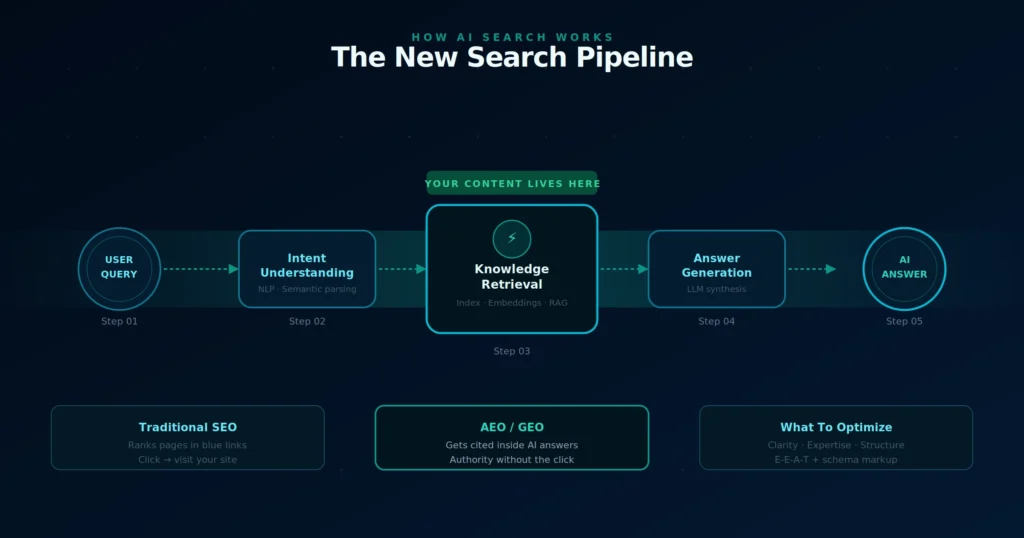
Traditional SEO was about ranking on search engine results pages. GEO is about becoming part of the output itself the actual answer the AI delivers to a user’s question.
When someone asks Perplexity or chat gpt “Which is the best digital marketing academy in Kochi?” the platform pulls from dozens of sources across the web and synthesizes a comprehensive answer. GEO is the discipline of making sure your brand, your content, and your expertise are among those sources.
The distinction is important. In SEO, you compete for a position on a SERP. In GEO, you compete to be included in the AI search.
Why GEO Matters More Than Ever?
AI systems increasingly act like digital sales representatives. They can recommend a product, explain its benefits, compare it to alternatives, and in some cases complete a purchase on the user’s behalf through what is known as agentic commerce.
If your brand is not being mentioned and cited in these AI-generated responses, you are being left out of conversations that directly influence buying decisions.
The benefits of investing in GEO are practical and measurable.
Brands that appear in AI-generated answers gain organic visibility without ongoing ad spend, attract higher-intent visitors who are already educated about what they are looking for, and build credibility as authoritative sources in their industry.
A paid campaign that stops the moment you pause the budget, a well-optimized piece of content can drive AI-sourced visibility around the clock.
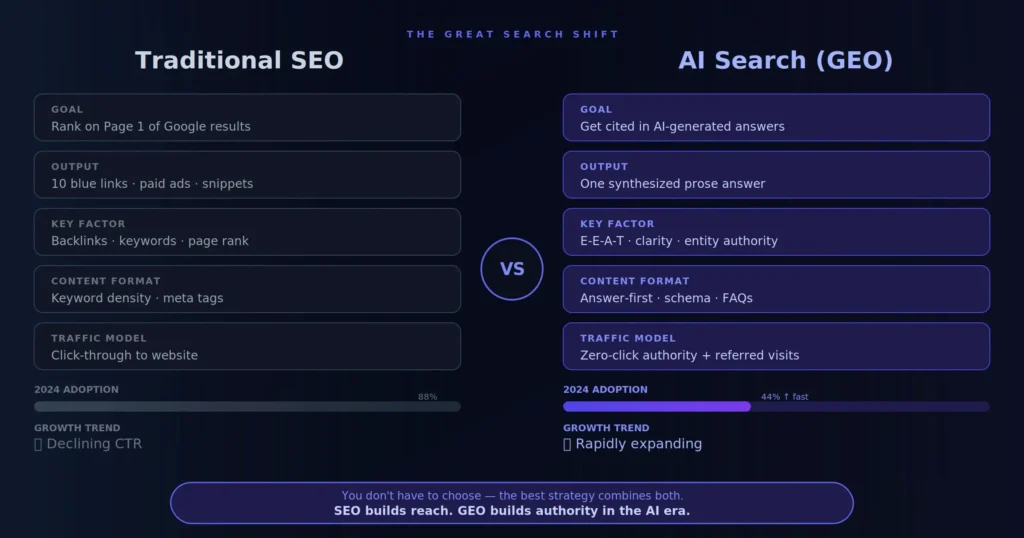
GEO vs. SEO: Complementary, Not Competing
One of the most important things to understand about GEO is that it does not replace SEO — it works alongside it.
SEO focuses on helping your pages rank in traditional search results. GEO focuses on making your content citable, trustworthy, and accessible enough that AI systems choose to include it in their answers. The tactics overlap significantly.
High-quality content, strong backlinks, technical site health, and topical authority all matter for both SEO and GEO.
The difference lies in emphasis. GEO places additional weight on clarity, extractability
Practical GEO Strategies That Work
Based on what we know about how AI search systems retrieve and evaluate content, several specific strategies consistently improve generative engine visibility.
Publish consistently around topics your brand owns.
AI systems build associations between brands and subject areas over time. The more your content consistently covers a specific topic with depth and accuracy, the more likely an AI engine is to recognize your brand as a credible source on that topic.
Make your content technically accessible.
AI crawlers can struggle to process pages that rely heavily on client-side JavaScript rendering. If your content only loads after a browser executes scripts, it may never be read by the AI systems you want to impress. Server-side rendering is increasingly important for AI visibility.
Use quotes and statistics deliberately.
Research analyzing thousands of real-world queries found that content containing quotes and data-backed statistics performed significantly better in AI-generated responses than content without them. Authoritative numbers and expert citations give AI systems high-confidence material to work with.
Keep your content fresh.
AI tools prioritize current information. Regularly updating your most important content signals to AI systems that your pages reflect the latest knowledge in your field.
Build a presence on UGC platforms.
Platforms like Reddit, YouTube, and community forums carry outsized influence in AI-generated answers. Brand presence, discussions, and reviews on these platforms can meaningfully increase the chance of being mentioned in AI responses.
Consider your Wikipedia footprint.
Wikipedia is widely referenced in AI training data. An accurate, well-maintained Wikipedia entry for your brand or industry may boost the likelihood of being cited by AI search systems.
How to Track Your GEO Performance
In 2026, visibility also means being the source an AI references when someone asks a question your business could answer. It means being cited in a summary, recommended in a comparison, or included in a synthesized overview that a potential customer reads before they ever type your brand name directly.
If you want your business to appear in the answers your customers are already receiving, GEO is no longer optional. It is the strategy.
Why AI Search Optimization Matters More Than Ever in 2026
1. AI Search Is Mainstream Now
By 2026, AI-powered search is no longer a novelty used by early adopters. It is the default mode of searching for hundreds of millions of users globally. Google’s AI Overviews now appear on the majority of informational queries. ChatGPT’s browsing capabilities handle millions of product and service searches daily. Perplexity has become the go-to research tool for professionals, students, and entrepreneurs.
2. The Zero-Click Era Rewards AI-Ready Content
Effective AI search optimization means your brand name, your expertise, and your solutions appear inside those AI-generated answers. It means being cited, referenced, and recommended by the AI engine itself. In a zero-click world, being visible inside the AI answer is the click
3. AI Search Optimization Drives Qualified Leads
One of the most compelling reasons to invest in AI search optimization in 2026 is lead quality. AI search engines are used by people who are actively seeking specific, nuanced answers — not casual browsers.
When an AI-powered search engine cites your business as the answer to a detailed query, the user arriving at your site already trusts you.
4. Your Competitors Are Already Doing It
If your competitors are appearing in AI-generated answers and you are not, the gap in trust and visibility will only widen. AI search optimization is not something you can afford to delay.
Core Pillars of AI Search Optimization in 2026
Conversational, Question-Based Content
Instead of writing a blog titled “Digital Marketing,” write one titled “What Is the Best Digital Marketing agency for a Small Company in 2026?” This kind of content is precisely what AI search optimization demands.
Structured Data and Schema Markup
AI systems parse structured data to quickly understand what your page is about, who wrote it, and what questions it answers. Implementing schema markup for articles, FAQs, products, services, and local businesses is one of the highest-leverage actions you can take for AI search optimization.
E-E-A-T: Experience, Expertise, Authoritativeness, Trust
Google’s E-E-A-T framework is baked directly into how AI systems assess which sources to cite. Strong AI search optimization means building your brand’s demonstrated expertise, earning citations from authoritative sources, and making your content’s authorship and credentials crystal clear.
Concise, Citable Answers
AI engines want passages they can quote. Every key article should include a clear, concise paragraph — ideally 40 to 60 words — that directly answers the primary question. This is sometimes called an “AI snippet.” Writing these deliberately is a cornerstone technique in any serious AI search optimization strategy.
Multimodal Content Optimization
AI search now indexes and evaluates video, audio, images, and text. Optimizing your YouTube transcripts, podcast descriptions, image alt text, and infographics is increasingly part of comprehensive AI search optimization. The businesses winning in AI search in 2026 treat every content format as an opportunity to be cited.
The Business Case: ROI of AI Search Optimization
Investing in AI search optimization in 2026 delivers measurable returns across multiple dimensions:
Brand visibility: Appearing in AI-generated answers positions your business as the authority in your space, even without paid advertising.
Organic traffic quality: AI-referred visitors convert at significantly higher rates because they arrive pre-educated and pre-trusting.
Competitive moat: The topical authority you build through AI search optimization is compounding — the more you earn, the harder it is to displace.
Cost efficiency: Unlike paid ads, AI search optimization generates ongoing returns from a single piece of optimized content.
Generative Engine Optimization is not a passing trend or a niche technical concern for advanced SEO practitioners. It is the next chapter in how businesses build visibility online, and that chapter is already underway.
In 2026, search engines are powered by advanced artificial intelligence and Large Language Models (LLMs).
Unlike traditional SEO, which focused heavily on ranking for specific keywords in a list, AI search optimization focuses on becoming the “source of truth” for the AI’s answers.
Instead of focusing solely on search engine rankings (i.e., SEO), GEO is about becoming part of the output that AI systems deliver known as agentic search.
This is not a trend. This is the new reality of search in 2026.